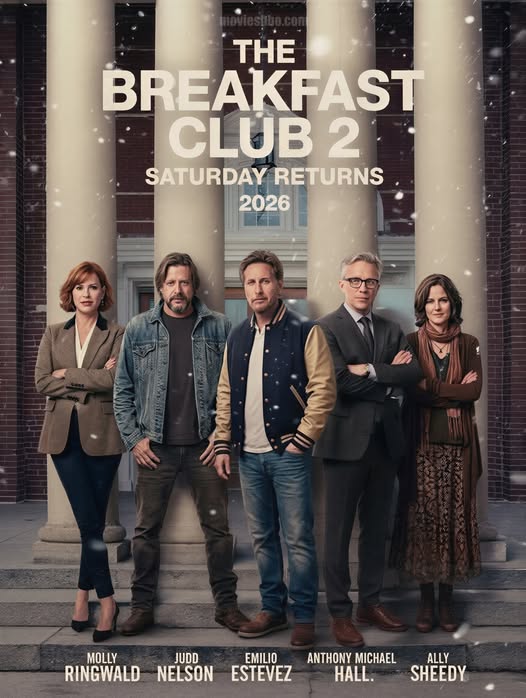
“You never forget who you were.”
More than four decades after a single Saturday detention reshaped teen cinema, The Breakfast Club 2: One More Saturday (2026) returns with a sequel that understands exactly what time does—and doesn’t—heal. This isn’t a nostalgia play built on catchphrases or callbacks. It’s a thoughtful, emotionally grounded continuation that asks a harder question: What happens to the labels we outgrow, but never fully escape?
The film reunites the original five in the same high school, but under profoundly different circumstances. They’re no longer teenagers killing time under fluorescent lights. They’re adults—parents, professionals, partners, and strangers to the people they once promised to become. Yet when they walk those familiar halls again, something stirs. The walls remember. And so do they.
What unfolds over one long Saturday is less a reunion and more a reckoning. The conversations that once cracked open adolescent defenses now cut deeper, shaped by decades of compromise, success, disappointment, and survival. Who lived the life they imagined? Who didn’t? And who stopped dreaming altogether because it felt safer?
The brilliance of One More Saturday lies in its restraint. The film resists easy sentimentality, allowing silence and subtext to do as much work as dialogue. Old dynamics resurface—not as jokes, but as emotional patterns that never quite went away. Humor still flickers, but it’s quieter now, edged with melancholy and self-awareness.
Each character carries adulthood differently. Some have found stability but lost passion. Others chased freedom and paid for it in ways they never expected. The labels—brain, athlete, basket case, princess, rebel—linger like ghosts, forcing each of them to confront whether those identities shaped their lives… or limited them.
Visually and tonally, the film honors the simplicity of the original. There’s no need for spectacle. The power comes from proximity: faces in close conversation, rooms heavy with unspoken history, and the slow realization that healing doesn’t come from forgetting the past—but from finally telling the truth about it.
The Breakfast Club 2: One More Saturday speaks directly to the audience that grew up with the first film. It understands aging not as a loss of relevance, but as a deeper emotional landscape. It suggests that growth isn’t linear, closure isn’t guaranteed, and some wounds only soften when we’re brave enough to look at them again.
This sequel doesn’t try to recreate a moment.
It creates a conversation—one that continues long after the final bell.
Because detention doesn’t always end in high school.
Sometimes, it follows you… until you’re ready to face it. 🎓
